


The 2026 documentary titled The AI Doc: Or How I Became an Apocaloptimist is a polished, beautifully illustrated, but ultimately inattentive work of AI propaganda. Beyond that, the question I’ll mainly explore here is whether The AI Doc is a bad instance of pro-AI propaganda, or a bad instance that’s anti-AI.
The answer is “Yes.” I’ll explain.
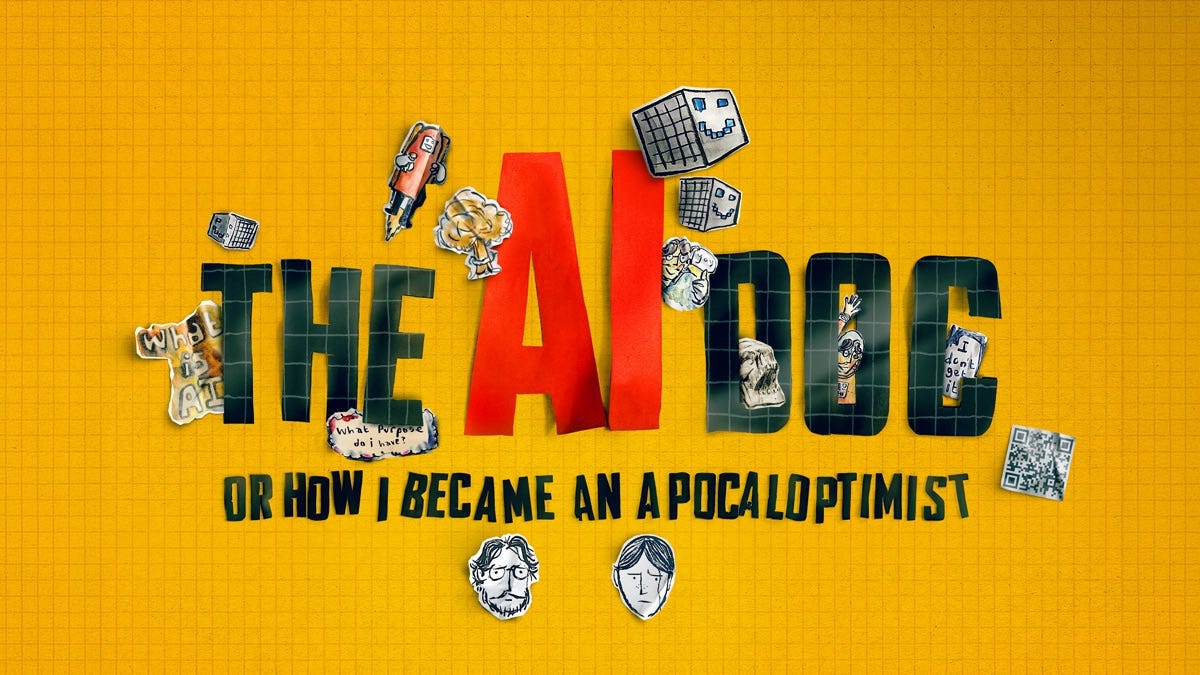
To illustrate, consider one of the film’s first subjects: Eliezer Yudkowsky. Yudkowski, author of the cheerily-titled polemic If Anyone Build It, Everyone Dies, states his concerns about a homicidal superintelligent AI, and in so doing sets the film’s narrative stakes. I have no issue with this storytelling tactic; every good tale needs its version of Voldemort. But as you’ll soon see, my main issue with The AI Doc is that it chooses the wrong Voldemort, which is a shame; AI offers up so many Voldemorts to choose from.
The movie received an aggregate score of 89% on Rotten Tomatoes. In choosing it as one of their “critic’s picks,” Variety’s Owen Glieberman describes it as “...a scary, dizzying and essential documentary. If you have any interest in artificial intelligence (which is to say: the future), you should go out and see it right now.”
Of course, not everyone agrees. One audience review pinned to the Rotten Tomatoes The AI Doc page observes that the “…interviews feel less like interrogation and more like guided PR, with softballs lobbed at people who, to their credit, manage to say remarkably little in response.” I think this latter review is closer to the mark than Glieberman’s, as it says more about the film’s substance than its stylistic flourishes. What the film does manage to say, it does so unwittingly.
For example, very early in the film, director Daniel Roher delivers the news that AI “dwarfs the powers of all other technologies combined.” This is an extraordinary claim that requires extraordinary evidence, of which the film offers none unless you count the word of a series of men who essentially repeat that claim - AI is the most powerful tech ever built - while also not disclosing they have massive financial stakes tied to that very claim. It is, in other words, exactly what you’d expect from the CEO of a pre-IPO firm like OpenAI or Anthropic about their product. It’s also what the head of a non-profit whose funding is based on the potential of that claim delivering utopia, or conversely, delivering Armageddon.
This is the most powerful tech ever created, and also the most dangerous, they claim. By far! So we need trillions of your dollars to build it. At the same time, we also need trillions of your dollars to ensure AI won’t cause great harm. Especially when coming from those who stand to directly benefit, assertions like these are self-serving and disingenuous.
Beyond that, what your correspondent has to say about the AI Doc is that it’s shallow, ineffective, AI-friendly agitprop that doesn’t trust its audience to engage with any of the ethical complexities of AI. I.e., if you want to hear a rehash of the vague, dystopian sci-fi scenarios that concentrate power and wealth into the pockets of the film’s headline subjects - Sam Altman, Dario Amodei, Eliezer Yudkowsky - then you’ll love The AI Doc. If, on the other hand, you’re expecting something beyond hand-waving about the real, immediate, concrete issues posed by AI and the AI buildout that I discuss in Lies - issues like massive energy consumption, financial stability, displacement of human labor, exploitation of a poor, brown, and remote workforce - then I’d advise putting something else in your queue. By focusing almost exclusively on AI industry CEOs and think tank figures rather than actual computer and cognitive science experts, the film really only wrestles with the question of how a PR campaign impacts the anxiety levels of a single family of privilege. The AI Doc offers little more than a parade of middle-aged white men suffering from main character syndrome.
Otherwise, it’s great.
However, that’s not my main issue with the film. The primary reason why I find The AI Doc so lacking is because of what I view as The AI Doc’s central conceit, which is that it pretends to offer two sides of the AI “argument.” The film spends the first hour pitting AI “doomers” like Yudkowsky on one side of this divide, saying things like “I know AI experts who won’t have kids,” while on the other side are the AI “boomers” like Sam Altman, Demis Hassabis, and the Amodei siblings. (Apparently, Zuck declined, while xAI’s Elon Musk agreed to be in the doc but never showed up.)
What I’m arguing instead is that an AI doomer like Eliezer “everyone dies” Yudkowsky, and an AI boomer like Sam Altman, who once used “eleizer yudkowski fan fiction account” as his Twitter bio, are both presenting the same AI narrative. They’re all engaged in the same delusions, with only mild variations in which choose-your-own-path plotlines they favor. Some think AI will wake up and build a utopia on Mars. Some think AI will wake up and turn humanity into fertilizer. But almost all think that AI will help them freeze their heads, or wieners, some other body part that will make them functionally immortal.
That is, almost all the subjects featured in The AI Doc are all disciples of the same TESCREAL religion. And they’re all reading from the same cynical business plan: selling you panic-as-a-service.
And if all of this sounds like too harsh a movie review, know that at the end of theatrical screenings filmmakers presented a QR code that invited its audience to visit the film’s companion website, which presented a list of ways you can “get involved.” Any guesses about one of the places it suggests?
80,000 Hours, a non-profit that’s part of the Effective Altruism movement!
Technically speaking, the filmmakers delegated the QR presentation to Tristan Harris, who the documentary positions as a sort of middle ground, adult-in-the-room figure between these two allegedly warring AI factions. But Tristan Harris’s own nonprofit, the Center for Humane Technology, is also EA-aligned. receiving a half a million dollar donation, which it does not disclose on its website, from… Max Tegmark and Jan Taalin’s Future of Life Institute!
Tristan Harris. Eliezer Yudkowski. Sam Altman. Elon Musk. Jann Tallin. And to that list now we can now add Jacob Coxon. All of these guys - high off of the exact same AI supply.
There’s an unattributed quote in the Intro of Lies about how AI will “solve… math, physics, chemistry, and materials science.” The person who said that was one of The AI Doc’s featured “boomers,” one who was talking director and father-to-be Daniel Roher down from off the ledge. That gentleman is named Peter Diamandis, who is the co-chair of… Singularity University! Since (at least) 2008, Diamandis has saying the Singularity is nigh, and selling you a course to learn more about it. And who’s the co-chair of Singularity University, which to be clear is a deceptively named private business, and no more a University than Trump University?
Ray Kurzweil! Mr. Singularity himself. (Speaking of villains: if I become the Joker while publishing this newsletter, this is why.)
And who does The AI Doc feature immediately following Diamandis? Guillaume Verdon, co-founder of the effective accelerationist movement and the start-up company Extropic AI.
For those scoring at home: Effective accelerationism is an even more extreme denomination of Effective Altruism. It’s the version that adds Extropianism and Cosmism into the cocktail. Effective accelerationists are of the completely rational and scientifically supported belief that destroying all the earth’s plants and animals - you know, the stuff keeping us alive - is just fine if that’s the sacrifice necessary to accelerate the arrival of AGI, because that’s the thing that will mean Utopia for humans. So if one of the film’s subjects argues, as Sneha Revanur does, that predictive crime algorithms should not replace cash bail programs in criminal justice, and this argument causes a two-year delay in the advent of AGI (as though something like that could even be measured), then according to an effective accelerationist like Guillaume Verdon, that two-year delay caused by Revanur is tantamount to murder. Revanur is a mass murderer, as she’s wiped out all future humans who would have otherwise been born into Utopia. Oh, and the Utopia is in space.
Cool. Nothing weird about that at all.
If you ever see “e/acc” in the signature line of an email or social media post, you now know what you’re seeing. Marc Andreesson, who has written that slowing down AI is “a form of murder,” and infamous pharma cretin Martin Shrikeli both use “e/acc” in their social media profiles, which is probably all you need to know.
Because whether it’s Harris, Diamandis, Altman, or Yudkowsky, what The AI Doc misses is that they’re all on the same fucking team! If you were watching a soccer match, and the announcer was saying that Argentina’s forward Lionel Messi and Argentina’s goalkeeper Emiliano Martínez were on two different teams, you’d likely turn down the TV’s sound. Yet this is precisely what The AI Doc posits to its viewers over its runtime.
Because the information I’m presenting here is and was readily available to AI Doc’s filmmakers. So what really burns my biscuits about the doc, and by extension the relatively uncritical critical reaction to it, is this facade of balance; of a mental Quidditch match between team Dystopia vs team Utopia. On closer inspection, The AI Doc offers us what feels like 50 dull, self-interested, middle-aged white men who are all selling you a book, a course, or stock in their company, counterbalanced by roughly three women who get very little screen time.
Yes, the movie features both Temnit Gebru and Emily Bender, which is great, but between the two of them, they get about 12 words in edgewise at about the 55 minute mark, which is awful and kind of makes my point. And even those lines are edited like the rest of the film, using a frenetic style more suited for a music video than contemplative exploration. The result, as the audience critic observed, is “a lot of dramatic music and very little insight.”
In my view, the best quote in The AI Doc comes not from an AI wonk, but rather from a historian. Towards the very end of the film, Yuval Noah Harari says, contra a good half dozen AI wonks who say (incorrectly) that intelligence is only pattern recognition:
“Intelligence is the ability to solve problems. Wisdom is the ability to know which problems to solve.”
Contained in this quote lies the film’s missed opportunity. It may be titled The AI Doc, but by failing to notice the AI snake eating its own tail, the filmmakers completely miss the TESCREAL ouroboros hiding in plain sight.
This piece draws on reporting, analysis, and excerpts from the book Lies My Tech Bro Told Me, which covers the real-world impact of Silicon Valley lies and what the non-billionaires can do about it.