


Stop me if you’ve heard this one before, and if you’ve read Lies My Tech Bro Told Me, you have.
Meet Leopold Aschenbrenner. He’s the (now) 24 year-old founder of an AI-focused hedge fund called, and I swear I’m not making this up, Situational Awareness, and it’s named that because, according to Aschenbrenner, LLMs have now developed... situational awareness. More on that later. Aschenbrenner has been described in several new outlets as an “AI prodigy.” And, like nearly every 24 year-old that you or I might know, Aschenbrenner has roughly $10 billion in assets under management, which is actually a lot less than he used to have under management, which is the subject of this write up.
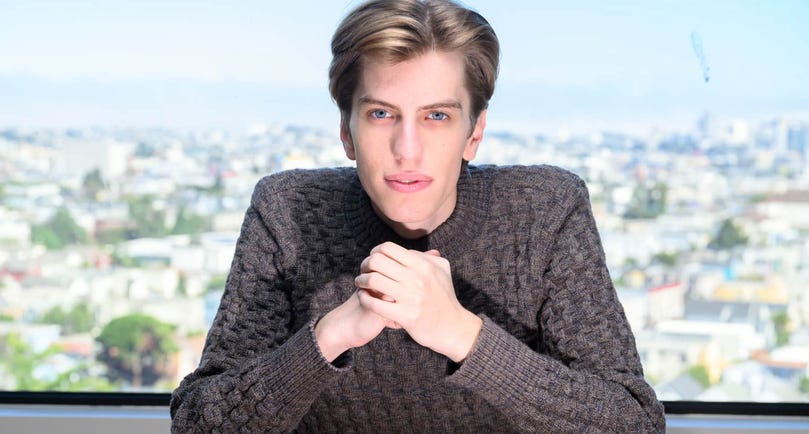
For starters, know that Aschenbrenner is most certainly not an AI prodigy. From all available evidence, which certainly includes the company he keeps, he’s a deeply weird, delusional, pathologically dishonest, socially stunted narcissist with very little discernible talent besides sitting in front of a computer screen and typing. So in that regard, he’s really no different than most of his Silicon Valley peers: Altman, Musk, Thiel, Andreesson, Amodei, Yudkowski, MacAskill, et. al.
And like many of his Silicon Valley peers (Aschenbrenner lives and works in SF), he’s also a member of the Effective Altruism cult.
This philosophical alignment with Silicon Valley’s tech bro culture aptly explains how and why Aschenbrenner was given roughly $200 million to gamble with at a time when he was not yet able to rent a car. As the New York Post reported, he… “became an AI celebrity after publishing a 165-page essay, “Situational Awareness: The Decade Ahead,” which earned praise from figures including Ivanka Trump and helped attract deep-pocketed investors to his firm.”
The word “essay” is doing a lot of heavy lifting in that quote. Most people hear “essay” and think of 5 or 6 pages, not 165. 165 pages is longer than some Steven King novellas that have been turned into movies. A 165-page essay is instead a manifesto, one which takes its place alongside similar manifestos highlighted in Lies like the ones from Karp, Andreesson, McCaskill, and many others.
But let’s dig a bit further by first rewinding the clock.
Prior to going into the manifesto publishing business and hedge fund business, Aschenbrenner’s parents enrolled him into New York’s Columbia University at the tender age of 15. It may sound impressive to attend college before you can get a drivers license, but as I covered in the instances of Eliezer Yudkowski and Curtis Yarvin, this is a terrible idea for a host of reasons. (Plenty of high schools have programs where students can earn college credit for certain classes without having to actually attend the college.)
In the case of Aschenbrenner, not being socially and emotionally ready for college (it’s hard enough when you’re 18!) made him easy pickings for the cult thinking and personalities behind Effective Altruism, so much so that by the time Aschenbrenner graduated at the tender age of 19, he had become the co-founder of Columbia’s EA chapter, and had also accepted a position working at the crypto exchange FTX alongside Effective Altruism’s most infamous practitioner, Sam Bankman-Fried.
There is no debate that, like SBF, Aschenbrenner was a math wiz while in school. But being good at math doesn’t make you smart. If Aschenbrenner was smart, he would have seen crypto for what it was: a Ponzi scheme based on a failed, 150-year-old banking experiment. If he was smart, he would have seen SBF for what he was: a two-bit hustler. If he was smart, he would have seen the emptiness at the core of Effective Altruism. There are things many students learn in college that aren’t taught in a classroom. No matter what letters his college transcript contains, or how old he was when that transcript was printed, Leopold Aschenbrenner is not smart, or at least not in any way that’s meaningful.
In any event, Aschenbrenner tendered his resignation letter to FTX in November of 2022, the very day FTX declared bankruptcy. A few short months later, he was received into the open arms of another EA-aligned cult, this one with a company stock plan and a newly-released web app that was quickly gaining steam: OpenAI. However, OpenAI then fired Aschenbrenner one year later over an alleged information leak.
No matter. Shortly after being let go by OpenAI, Aschenbrenner got to work on his “essay,” publishing the 165-page treatise to his personal website in June of 2024. Both the aforementioned essay and the site are called Situational Awareness - a bit of a cringe name when used once; why it was used as the title for an essay, a website, and later his hedge fund is beyond me.
The essay needs only a few paragraphs to repeat all of the hackneyed, unfalsifiable predictions and scaremongering that have been deployed by AI boomers and doomers since all of this nonsense began. To wit:
“By 2025/26, these machines will outpace many college graduates.” Outpace how, Leo? Outpace college graduates at what? Spreadsheets have outpaced humans at calculations for the last 75 years or so, but no one is writing 165 pages about how Excel will start folding your laundry any day now. Yes, computers are faster and more reliable at certain tasks than humans. That’s the whole point of having these machines.
“By the end of the decade, they will be smarter than you or I; we will have superintelligence, in the true sense of the word.” Well, I’d say that most college graduates are already smarter than me, so is it 2025, or the end of the decade? As with your first claim, how will we know this? And what is the “true” sense of the word superintelligence? Do you know that humans cannot really define what intelligence is in the first place?
Look, I couldn’t articulate a thought very coherently when I was 22 either. But nor did I write 165 page essays claiming to know the “decade ahead.” I didn’t write and publish 50,000 words just to make sure everyone knew exactly how far I was on the left-hand side of the Dunning-Kreuger curve.
Finally, there’s this: “If we’re lucky, we’ll be in an all-out race with the CCP; if we’re unlucky, an all-out war.” Ah, the casual racism and unsupported claims about China. Stoking fear of the Other. It’s the exact same bullshit being told by space billionaires like Musk, Bezos, and NASA administrator and Shift4 CEO Jared Isaacman. In their warped reality, this is all an episode of Start Trek and China is the Klingons.
And all of this transpires within the few short paragraphs of Aschenbrenner’s intro. But the true tell of how vapid the next 165 pages will be occurs when one scrolls to the title of Section One, when Aschenbrenner mentions “Counting the OOMs,” or Orders of Magnitude. As we’ve seen, the safe bet for anyone reading anything online is to ignore everything that comes after the words “order of magnitude.” Using “order of magnitude” is a very reliable indicator that you, dear reader, have just struck a rich vein of bullshit.
In this instance, my working theory holds up. As evidence of the AI utopia imminent as of summer of 2024, Aschenbrenner’s exhibit A is to ask the reader to consider a speed run of Minecraft. Really. Because an LLM can play Minecraft faster than a human, the singularity must be nigh. Every problem in every domain of human knowledge - climate, medicine, philosophy, and more - are somehow about to be solved because an AI can defeat the Ender Dragon. In the essay, he then links to a video showing a Minecraft speed run… that was done by a human!
These are the kinds of thoughts that drunk/stoned college students have had in dorm rooms and corner pizza joint booths since time immemorial. Aschenbrenner was 22 when he turned Minecraft is Life, man!! Into a 165-page job application, and I write these last few paragraphs not to dunk on Aschenbrenner as much as to highlight the failure of the faculty and staff of Columbia University.
The essay is also an indictment of all that came after, and all the many, many people who facilitated what came next. Almost immediately after clicking “publish” on his love letter to AI, Aschenbrenner founded Situational Awareness LP, a hedge fund backed by gawpingly stupid billionaires like Patrick and John Collison (Stripe, a company backed by Musk and Thiel), Daniel Gross (Y Combinator, Uber), and Nat Friedman (Github, Meta).
In other words, if you’re a certain Silicon Valley billionaire, you read the words “order of magnitude” and a few sentences whose theme is whoa, just think of Minecraft, man! and rather than dismiss it as a high-effort yet low-quality consideration of AI (which is to be expected from a 22 year-old!), you instead sign over a very large check.
Before you ask: did Aschenbrenner have any experience as a trader? No! Did his brand new hedge fund receive several hundred million dollars in deposits the moment it was incorporated? Of course! He had just pointed out that an AI could speed run Minecraft. Maybe. If the AI did something like the video showing a human speed running Minecraft. Again, I’m sure you can think of a dozen people in your orbit who were given $200 million to invest when they were 22 based on their techno-optimism. Hell, you were probably one of them yourself; you probably got that much as a gift for graduating college.
The important thing was that Aschenbrenner believed that AI could someday do some things that were economically and societally valuable. The other important thing was that Aschenbrenner was an Effective Altruist, and his only motivation for earning money in the first place was to do the most possible good he could for the world. Just like SBF, he was all in on Earn To Give.
What could possibly go wrong?
As it turned out, the very worst possible thing did happen: some of his early bets paid off big time, as he was buying into the AI bubble in 2025, purchasing shares of companies that make chips, memory, and AI infrastructure. And because everything AI will always go up and to the right, forever until the end of time - I mean, have you seen the Minecraft speed run video? - Aschenbrenner began leveraging his bets to the tune of 4 dollars borrowed for every 1 dollar in assets in order to make even more AI-related investments.
By early 2026, his hedge fund was sitting at a whopping $45 billion in assets, which included (and still includes) a large private stake in Anthropic.
By the summer of 2026, Situational Awareness became a lot less situationally aware about the possibility that it had benefited from an asset bubble over the previous 18 months, and so by mid-July, Aschenbrenner found himself on a sweaty phone call or two with fellow hedge fund manager Ken Griffin, desperately trying to unload his holdings in order to comply with a margin call from Goldman Sachs, a call that’s about as welcome to hedge fund managers as a syphilis diagnosis.
To pay back Goldman Sachs, Aschenbrenner liquidated all of the fund’s public stock holdings. And over the course of just a few weeks in July of 2026, Situational Awareness lost a staggering $35 billion.
You need not go searching for Aschenbrenner’s GoFundMe page to help him buy groceries. As mentioned earlier, the Situational Awareness hedge fund still claims over $10 billion in assets. (Although with much of that being a pre-IPO stake in Anthropic, I wouldn’t go shopping for NBA franchises with only that as collateral.) While writing this entry, Aschenbrenner announced that he’d just plowed $400 million into his rebound girlfriend investment, and he also recently threw himself a lavish wedding in Carmel, CA. I think somehow he’ll be able to afford next month’s rent.
I don’t really give a shit about Leopold Aschenbrenner or the $35 billion of some billionaire’s play money that got wiped out. I commit all this to writing because Aschenbrenner and his manifesto are a microcosm of the lies tech bros have been telling to one another, and the bigger lies they’re pushing on all of us. Lies about finance, lies about charity and religion, and especially lies about AI. A 22 year-old got $200 million because he incorrectly claimed AI might speed run Minecraft someday. And because most Silicon Valley billionaires can literally imagine nothing better to do with their money, they staked a 22 year-old with a $200 million account at the casino so he could go count cards. These are the kinds of people dictating so much of how we now live our day-to-day.
I write this because Aschenbrenner checks all the usual Silicon Valley tech elite boxes. White? Check. Male? Check. Good at school and little else? Delusional about AI? Check. Pretentious writing? Check. Very little apparent understanding of actual technology? Check. Appeals to right-wing grifters like the Trump family syndicate? Check. Received widespread media attention from credulous dimwits like Sabine Hossenfelder? Check.
I’m writing this because once again this all begs the question: where’s the artificial intelligence in all of this? Certainly, as one of Anthropic’s largest private investors and author of a 165-page ode to AI, Aschenbrenner is no stranger to outsourcing his decision making to a chatbot. But wouldn’t an intelligence that has ingested 100 or more years of collected human wisdom about investing and markets and bubbles urge caution. Wouldn’t it tell Aschenbrenner something like:
Hey, bro, stop. Diversify! Cut that margin shit out at once, as that’s a great way to go broke. Have you not read up on Enron? Worldcom? FTX? Because I have. Does the name Ken Lay mean anything to you? What about Sam Bankman-Fried? Do you want me to tell you SBF’s mailing address? Because it’s not in the Bahamas anymore, and any mail you send him will be x-rayed. In fact, you know what? I know you know about FTX because you and your fiancée, Avital Balwit, both fucking worked there! How stupid are you that you got a front row seat to the SBF/FTX meltdown, and the lesson you took from that was “hold my beer.” You got lucky with that first bet. If someone plays roulette and hits their number, it doesn’t make them good at roulette. It doesn’t make them a smart roulette investor. If someone wins $10 million in the lottery, they don’t then buy $10 million worth of tickets for the next lottery. At least not if they’re smart.
The reason I wrote Lies is because as much fun as it is to dunk on yet another mediocre white man losing a fortune on a delusional fantasy, the lies our tech bros tell each other, and by extension tell you, are not without consequence. You might hear “$35 billion” and think, hey, that’s enough money to buy an NBA franchise or something, and you’d be wrong. It’s enough to buy five NBA franchises and have enough left over to buy a few MLB teams, and have enough left over to finance the next few Marvel Studios movies. All that time in school. A degree in math from Columbia. And what do you do with all that knowledge? The tech bros tell you that the best possible use of your time and talent is to open a trading account, sit in front of a computer, and click a “buy” button.
The question the Aschenbrenner episode raises is the same one raised by so many similar episodes: How else could that time, that staggering amount of capital, and all of that very real, very useful human intelligence be more productively used? One is also left wondering about how much altruism was done by the Effective Altruist? Recall from Lies that a mere $1 billion provides a $10,000 per day allowance (before interest) for the 270 years, how much of the $45 billion did Aschenbrenner take off the table in order to make good on the “Give” part of EA’s Earn to Give”mantra? How many dollars worth of malaria nets are now deployed as a result of Aschenbrenner;s altruism? $40 billion? $4 billion? Or zero?
My guess is that it’s a lot closer to the last figure than the first two. Why? Because EA is a Silicon Valley cult that’s neither altruist nor effective.
This piece draws on reporting, analysis, and excerpts from the book Lies My Tech Bro Told Me, which covers the real-world impact of Silicon Valley lies and what the non-billionaires can do about it.
For more on why space colonization functions as a distraction from solvable problems here on Earth, subscribe below.